





RAW vs JPG for AI HDR Editing: Dataventurer's Real-World Tests21767
Pages:
1
 Owner, Managing Editor and Publisher of WGAN Forum and WGAN-TV Podcast Fairfield, California |
TomSparks private msg quote post Address this user | |
| AI HDR editing platforms are now a standard part of many real estate photography workflows, and most of them claim JPG brackets produce essentially the same result as RAW. We Get Around Network (WGAN) member @Dataventurer decided to test that claim, along with a few other workflow assumptions, and generously agreed to share what he found. The test setup Dataventurer shot a 13-photo set at a listing in both JPG and RAW, using three-bracket sets two stops apart with the meter reading +0.3 to +0.7. His camera is an Olympus OM-D E-M1 Mark II (Micro Four Thirds) with a 9-18mm zoom. He ran both versions of the same set through several AI editing platforms, then imported each result into its own Lightroom folder so he could compare them side by side in Collections. Finding 1: RAW and JPG are not "nearly identical" In his tests, RAW brackets came back with more tonal gradation, especially on walls and ceilings, while JPG brackets tended to bleach out white walls. On some platforms the RAW versions also showed less lens pincushioning and less of a pink color cast. His takeaway: if your platform accepts RAW, test it against JPG on your own camera before defaulting to JPG for faster uploads. Every camera and lens combination will behave a little differently. Finding 2: RAW upload time doesn't have to slow you down The obvious objection to RAW is upload time. Dataventurer's answer is to start the RAW upload first and let it run while he does other work: copying video files and starting proxy renders in the background, importing exteriors into Lightroom and blending them with LR/Enfuse, and editing the Zillow 3D Home Tour. By the time all that is done, the interior edits are usually back and ready. The longer upload costs him nothing, and he gets better results from the same brackets. Finding 3: Compare results before you edit them His method is to judge each platform's output exactly as delivered, before any Lightroom work. Only then does he apply his preset to the strongest sets and fine-tune them. Tweaking everything first hides the differences you're trying to measure, and it also hides how much cleanup each platform leaves you per photo, which is the real cost to your workflow. Finding 4: Your bracket exposure matters A set shot as five brackets with the meter at -0.7 came back noticeably dark across the board. His three-bracket sets metered at +0.3 to +0.7 gave better starting points. If your AI edits keep coming back underexposed, check your capture settings before you blame the platform. Finding 5: The Micro Four Thirds lens correction gotcha On one platform, every image came back with heavy barrel distortion (up to +/-35 on Lightroom's distortion slider). Micro Four Thirds cameras store lens correction data in the file's metadata, and that platform wasn't reading it, so no correction was applied. Dataventurer worked through the problem with Google Gemini and landed on a fix: route the RAW files through Lightroom first and export from there, so the lens correction is applied before upload. He also found that exporting as lossy-compressed DNG cut file size from about 13MB to about 3MB per image, which sped up uploads considerably. If you shoot Micro Four Thirds or another system that relies on embedded lens corrections, run a test batch on any new AI editing platform and check your verticals before you trust it with a client job. Match the platform to the job Pricing across AI editing platforms varies widely. Higher-priced platforms often include on-platform tools like sky replacement, grass enhancement, and property line overlays. Those are valuable when you need them, but not every listing does. Dataventurer's approach is to know what each shoot actually requires and choose the platform that fits, rather than paying for features on every photo. Your turn These results come from one photographer, one camera system, and one home, and AI editing platforms update their models often, so your results may be different. Have you compared RAW and JPG on the platform you use? Found a smart way to work around upload times? Run into lens correction problems with a particular camera? Post your findings below. Side-by-side examples are especially helpful. Coming up: Dataventurer is deep into testing AI animation tools for 30-second listing reels and plans to share which tools, models, and platforms produce results fastest. Stay tuned. |
||
| Post 1 • IP flag post | ||

Coeur d'Alene, Idaho |
lilnitsch private msg quote post Address this user | |
Little different direction ~ I am toying with having ChatGPT cull my images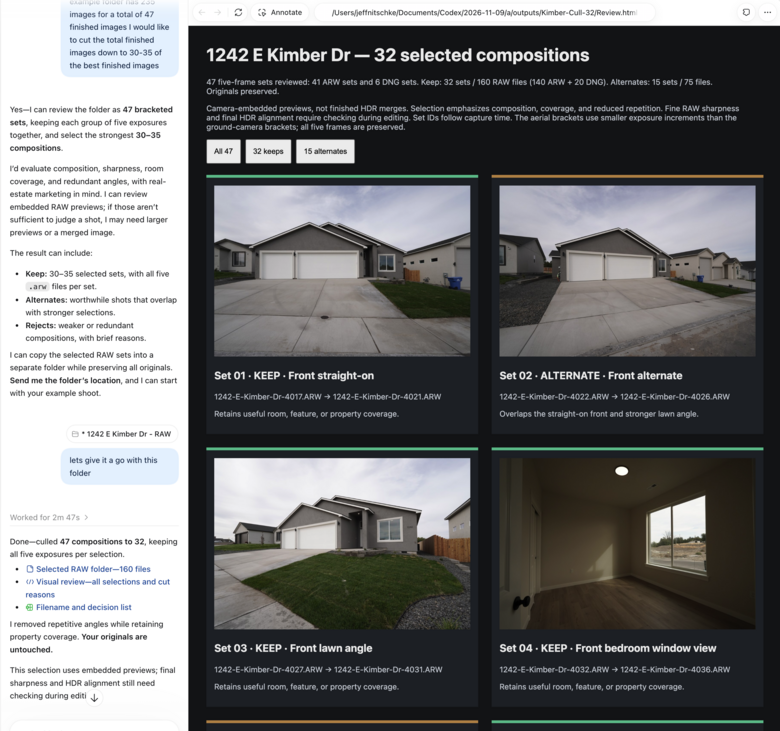 |
||
| Post 2 • IP flag post | ||
|
Coeur d'Alene, Idaho |
lilnitsch private msg quote post Address this user | |
| I am a Sony crop sensor shooter ~ I shoot 5 brackets 2 stops apart (Raw + jpg) and primarily use an editing team in Vietnam ~ shoot them over Raw images at the end of my day and have edited images the next morning with the exception of Sundays | ||
| Post 3 • IP flag post | ||
|
Owner, Managing Editor and Publisher of WGAN Forum and WGAN-TV Podcast Fairfield, California |
TomSparks private msg quote post Address this user | |
| @lilnitsch I've never shot real estate photos in RAW, just large jpg. At our peak of # of houses a week, I feel like my ISP would come out with a chainsaw and slice through my connection. I haven't seen any tool that does AI culling well, for real estate, or non real estate. IMHO the human eye is still winning over that for now. |
||
| Post 4 • IP flag post | ||
|
Coeur d'Alene, Idaho |
lilnitsch private msg quote post Address this user | |
I currently have 2gig bidirectional fiber and go up to 8gig service at my location As for culling I am in my early toying stage if chatGPT can at least do a once over my test folder of raw images it went through in a little over 2 minutes I still have final decision on images to be edited |
||
| Post 5 • IP flag post | ||
Pages:
1